
ABOUT

Talent is not enough –
you need skills!

Frida Kahlo, Jean-Michel Basquiat or Henri Rousseau – these are artists who did not complete formal art studies, yet they have left a lasting mark on art history. Their paths show that education is important, but it is not the only prerequisite for success in the cultural and creative industries. Success is increasingly determined by skills, courage to act and the ability to translate talent into specific projects.

Culture inspires, provokes thought and builds social engagement. The creative process develops innovation, empathy and agency. At the same time, the CCI sector is dynamic and demanding – in addition to passion, creativity, cooperation, communication, flexibility and entrepreneurship are also important. In a world where the labour market is changing faster than curricula, young people need tools that will allow them to find their place in this reality.

Our project was created for this very purpose. We combine art with game design, escape rooms and gamification to make learning an experience based on action, collaboration and solving real-world problems. We create a comprehensive support ecosystem: from substantive publications, through an educational platform with a micro-credential system, to video courses, podcasts and international workshops. We work with young people aged 15-30 who want to develop their passions in the creative sector, as well as with educators, mentors and youth workers.

Because talent is just the beginning. We help turn it into skills, experience and real career opportunities.

RESOURCES

Empowering Youth Creativity – The Talent Transformation Handboo

This handbook is the foundation of the project. It provides an in-depth introduction to the world of skills necessary in the cultural sector and creative industries. It shows how to develop creativity and innovation, build industry awareness, and strengthen flexibility, cooperation and communication skills. It combines theoretical context with practical tips on building a career, professional resilience and entrepreneurship. It is a tool that helps to understand the challenges of the contemporary CCI market and consciously prepare young people to function in it both as creators and initiators of their own ventures.

Escape Rooms for the Development of Competences in CCIs – Exploring the Intersection of Arts and Gamification

The second handbook is practical in nature and shows how to use escape room games as a tool for developing CCI competences. It focuses on designing educational games, building scenarios and adapting game mechanics to the real needs of young creators. Gamification is no longer just a form of entertainment – it becomes a method of developing critical thinking, cooperation, communication and creativity in realistic problem situations. The publication also addresses issues of accessibility and adaptation of activities to people with learning difficulties, so that the proposed methodology can be implemented in an inclusive and responsible manner.

Increasing Creativity and Innovation – learning platform

The digital educational platform is the central point of access to all project materials. It is an interactive development environment where users can follow a structured learning path and monitor their own progress. The platform has been designed to be intuitive and accessible, including for people with SLD. It combines knowledge, practice and evaluation tools to create modern support for young talents and educators.

Scenario-based learning sheets, video tutorials and podcasts

The project involves the creation of a comprehensive course comprising twelve video materials, twelve podcasts and twenty-four scenario-based educational cards. The content is based on realistic challenges faced by the CCI sector and guides participants through issues related to career building, international cooperation, personal branding and the development of entrepreneurial skills. The worksheets combine reflection with action, allowing participants to work on authentic professional situations. It is a coherent, modular path that works well for both individual and workshop work.

CCI-focused escape room games and workflows

Twelve model escape room games are being developed, designed specifically for the cultural and creative industries sector. Unlike the general tools available on the market, these games respond directly to the needs of young artists and creators. They develop problem-solving skills, collaboration, innovation and the ability to respond to unforeseen situations. Each game is accompanied by a detailed workflow that shows, step by step, how to implement it, adapt it to different audiences (including people with SLD) and how to evaluate the learning process. The methodology also allows for the creation of custom scenarios and further development of the tools.

Training Implementation Guide for Workshop Organisers

To ensure the sustainability of the project’s results, a practical guide for workshop organisers is being developed. It shows how to use the project materials in working with young people and how to adapt the tools to different educational contexts. It provides support for trainers and institutions that want to implement the project methodology in a conscious and effective manner.

National and International Workshops reports & Implementation Guide

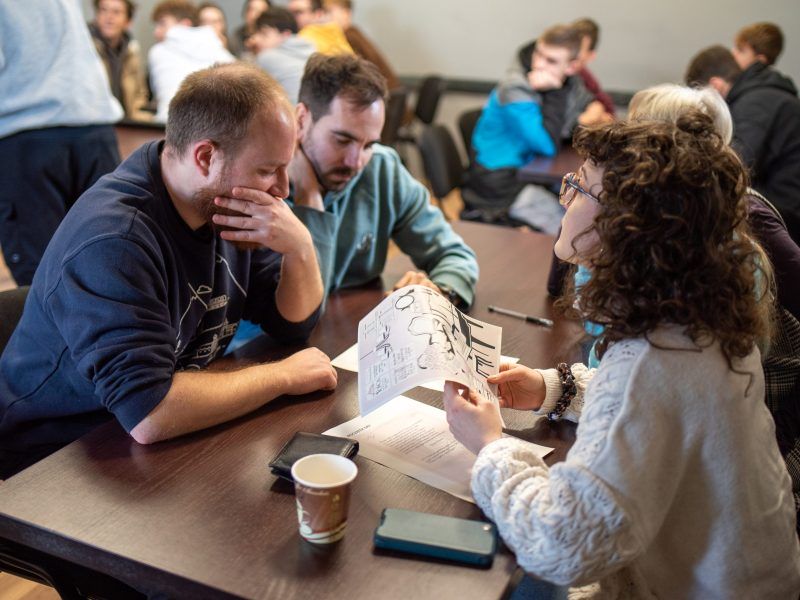
The project involves national workshops in Poland, Italy, Belgium and Macedonia, as well as an international workshop that will bring together participants from different parts of Europe. It is a space for testing and improving the tools developed, but also for jointly creating new solutions. During the workshops, participants design their own games – a total of twenty-two new escape room game concepts will be developed at national and international level. These activities strengthen cross-border cooperation, build networks of young creators and educators, and provide real support for the development of entrepreneurship in CCIs. All of the experiences will be compiled in a final implementation guide, which will enable further scaling and adaptation of the methodology in other organisations and countries.

The project creates a coherent support system – from reflection and knowledge, through practical tools, to international cooperation. All this so that young people can not only dream of working in the creative sector, but also consciously and competently build their future in it.

ARTICLES

PARTNERS

ARTeria Foundation is a non-governmental, non-profit organisation established in 2006, with nearly 20 years of experience working for the cultural and creative sectors (CCS). We design and implement projects and programmes that support artists, creators, and local and regional communities, grounding our activities in three core pillars: culture without borders, innovative education, and multidimensional cooperation.

Our strategic objective is to represent and strengthen the position of artists and creative professionals and to foster development through art, culture, creativity, heritage, and social innovation. For many years, we have been designing and delivering cross-sectoral and interdisciplinary initiatives in collaboration with artists and creators, educators, mentors, non-governmental organisations, cultural institutions, schools and universities, local authorities, and international partners.

Since the beginning of our activity, ARTeria has implemented over 40 national and international projects, funded, among others, by Erasmus+, Creative Europe, EEA and Norway Grants, the European Social Fund, and national funding schemes. We have organised hundreds of events, meetings, workshops, and training activities for artists, creative professionals, and local communities, and eight ARTeria projects (as coordinator or partner) have received the Erasmus+ Good Practice.

ARTeria is actively engaged at the European level, participating in networks, partnerships, and policy dialogues for culture and creativity. We are recognised as an experienced and reliable partner supporting the cultural and creative sectors and education through innovative projects, capacity building, and strengthening the role of creators in a rapidly changing world.

ARTeria is a member of international networks: Culture Action Europe, ENCATC, Creative Fed. It is also a member of Creative Pact for Skills.

Quality Culture logo

Quality Culture is an ed-tech company which emerged in 2021 as a dynamic force in Milan’s innovation landscape, rapidly establishing itself as a catalyst for social and digital transformation across Europe. As a forward-thinking SME, we have crafted a unique space where technological advancement meets social progress, where every initiative serves as a stepping stone toward a more equitable and sustainable future.

Our mission centers on unlocking human potential and fostering positive social change throughout Europe. We believe in the transformative power of combining digital innovation with creativity and social inclusion, working tirelessly to bridge the gaps that prevent talented individuals from reaching their full potential. This commitment manifests in our focus on reducing gender disparities in the Italian job market, promoting environmental sustainability, fostering creativity and artistic expression, and creating accessible opportunities for disadvantaged groups.

We approach each project with a deep commitment to our core values: innovation for meaningful impact, empowerment through education, sustainable development aligned with SDGs, gender equality, and inclusive growth. These principles guide our work with various target groups, including young people, creative people, artists, unemployed persons, and migrants, ensuring that our initiatives create lasting positive change in communities across Europe.

Press to EXIT. Founded in 2004 and established as an association in 2010, Press to Exit Project Space is a mid-sized, independent cultural organization based in Skopje, North Macedonia. As a non-profit NGO, it serves as a platform for artistic and curatorial research, production, and cultural promotion, dedicated to advancing contemporary visual arts, curatorial practice, and independent cultural development. Committed to artistic excellence, civic engagement, and cultural enrichment, the organization operates independently of political and commercial agendas while strengthening the cultural ecosystem locally and internationally. 

Education and youth empowerment lie at the heart of Press to Exit’s mission. Through mentorship programs, cooperation with universities, cultural institutions, and creative industry stakeholders, it supports the professional growth of emerging artists and curators, ensuring access to training, mentorship, and international opportunities. Core initiatives such as the Visiting Curatorial Initiative, New Project Productions, and a diverse program of exhibitions and lectures promote artistic experimentation, social engagement, and public dialogue beyond institutional frameworks.

The organization has strong experience in international collaboration, especially within Erasmus+, having co-developed The Toolkit under the Partnership for Creative Apprenticeships (P4CA) project. Building on this expertise, it is now a partner in Partnership for Creative Careers (P2CC), fostering employability and innovation among young creatives. It also participates in Empowering Youth Talents, led by Fundacja Arteria, which focuses on nurturing youth creativity, cross-sector collaboration, and cultural entrepreneurship.

A founding member of JADRO – Association of the Independent Cultural Scene in Macedonia, Press to Exit operates from Skopje and collaborates with key partners including the Centar-Jadro, MKC – Youth Cultural Center, and the Museum of Contemporary Art, Skopje, as well as the regional network Kooperativa.

Led by a multidisciplinary team of curators, cultural managers, and educators, the organization continues to play a vital role in shaping the next generation of artistic and cultural leaders while contributing to a resilient, inclusive, and internationally connected creative sector.

The Municipal Center of Culture and Arts (MOKiS) in Pyskowice is an institution provided by the city of Pyskowice. Our mission is the comprehensive development of participants, helping them identify and cultivate their talents while providing meaningful ways to spend their free time. MOKiS focuses on fostering creativity and curiosity, while also emphasizing essential social values.

The institution’s activities are carried out across three different facilities in the city – the main building, the Town Hall and the Station of Culture. MOKiS offers a wide range of classes including:

  • artistic, dance, and music classes,
  • theater and fine arts classes,
  • physical activities, such as aerobics for adults.


Moreover, MOKiS organises competitions, reviews, festivals, exhibitions, lectures, concerts, games nights and many more. These events attract both the people from Pyskowice and the surrounding areas. Everyone can find something that suits them.

Escape4Change is an Italian startup specializing in edutainment with a ready innovative solution that generates an impact on individuals and society. The start-up proposes a sustainable, adaptable, and flexible edutainment experience that could be integrated into different educational contexts and could be used to engage several targets to reflect and act on difficult topics of social relevance such as climate change, discrimination, urban green, circular economy, etc. These experiences allow any individual to live an emotional, fun, and compelling experience. The only necessary competencies required to join the experience are to be able to read and write. Furthermore, the experience is focused on team building and empathy, two key elements in the learning process of the teams that play the edu-escape games.

Escape4Change solution is:

  • UNIQUE for its educational focus and its approach that transform and innovate a simple collaborative game into an immersive and educational experience in which is possible to build competences and growth as individual.
  • EFFECTIVE & EFFICIENT because it’s designed to support participants to enter in an open learning process in which they can acquire new knowledge, going deeply in unknown aspects and build personal competencies and skills to act and become agents of change.
  • SUSTAINABLE because it is possible to replicate the experience with a wider audience and the solution can be integrated easily in formal and non-formal contexts to improve the impact of specific topics on participants.


Escape4Change has strong expertise in creating fun and educational game experiences including physical and digital escape rooms, gamified training, and cooperative games. In addition, the organisation has extensive skills in co-design, implementation and management of multilevel projects and actions.

The E4C solution consists of co-designing a physical or digital edutainment experience on highly relevant topics such as climate change, anti-racism, urban greening, circular economy, etc. The experience can be realised physically, in 2D, using basic digital tools (e.g. Internet connection and PC/Tablet/smartphone) or in an advanced form, with an additional investment in technology, edu-escape rooms could be developed in 3D.

Logopsycom is an education innovation center that creates and uses alternative methods or tools (digital or not) to accompany schools, VET centers, educational organizations, youngsters and parents. It was initially created as a care company specialized in learning disorders among youngsters, especially in “Dys” (Dyspraxia, Dysphasia, Dyslexia, etc.), also called Specific Learning Disorders (SLD), and therefore always works on the accessibility of content.

INSPIRATION

Check out the results of the Escape Rooms for CCISs project, which was the inspiration for this project.